Things We Don’t Do at Sabre: #1 Wasteful Warm-Ups
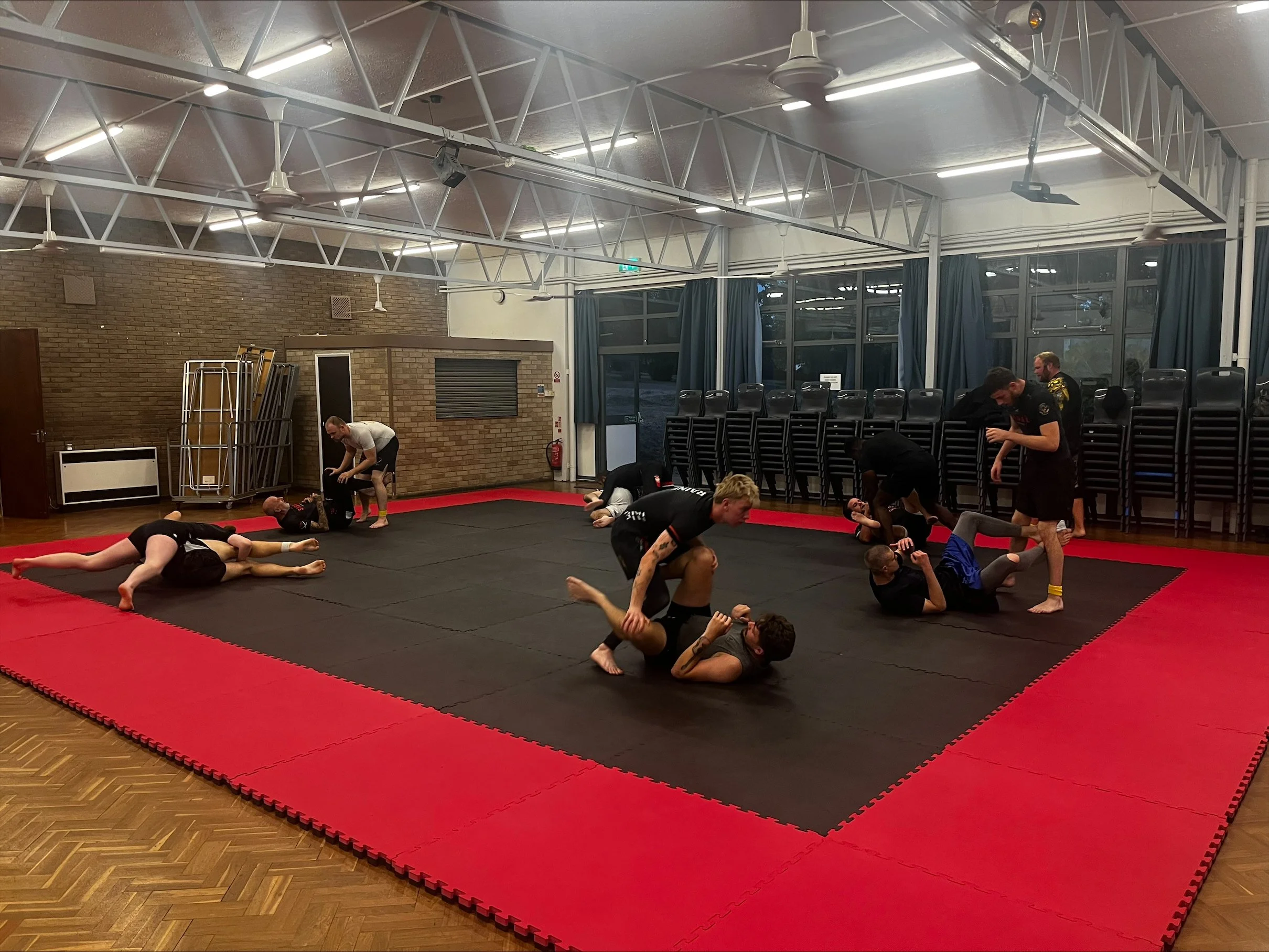
Starting the grappling lesson with relevant grappling movements. Give it a try!
Over the years, whilst learning BJJ, one of my least favourite parts of class was the warm-up.
I saw plenty of different approaches to traditional warm-ups. Some had merit, and I understood what they were trying to achieve, but I could never shake the feeling that there had to be a better way to start a BJJ class.
Perhaps my least favourite was the classic “run around in a circle” warm-up.Knees up. Heels up. Two facing in. Two facing out. Swing the right arm forward. Now the left. There’s nothing inherently wrong with any of those movements. They get the heart rate up and the muscles moving.
But what usually happens immediately afterwards?
Everyone sits down in a circle and listens to the first technique. They cool down again. So that first ten minutes of non-jiujitsu movement has served what purpose, exactly?
The other type of warm-up I encountered was the more Judo-influenced approach: breakfalls up and down the mats, shrimping, bridging, technical stand-ups, followed by a menagerie of animal movements. I actually enjoyed these warm-ups for a while. They certainly seemed more sport-specific than running around in a circle.
But even as a blue belt, I remember thinking: Why aren’t we just doing BJJ?
I know there are plenty of schools that still warm up this way. I think they’re wasting their students’ time. A little worse than that, actually.
I think they’re cheating them.
The average BJJ class is around an hour long. Your students are paying you to teach them the skills and knowledge of BJJ, and then to give them an opportunity to apply those skills.
When students are mindlessly running around in a circle, or performing their 7,698th shrimp along the mats, they aren’t learning BJJ. They’re spending a significant chunk of their limited training time doing something that could be done in a PE lesson. And that’s the important distinction.
I’m not particularly interested in whether a warm-up technically makes you warmer. Of course it does. I’m interested in whether it prepares you for the activity you’re about to perform.
At Sabre, every movement is a grappling movement, including the warm-up.
We’ve never run around in circles or swung our arms around simply because that’s what you’re supposed to do at the beginning of a martial arts class. The ecological approach to teaching, although it isn’t the only approach we use, is particularly useful here. You can simply start with a constraint-led game.
My friend Keeno, at Hertz Grappling, often begins wrestling sessions with the Circle Game: each partner tries to connect their hands around the leg, body or head of their opponent.
Everyone is moving. Everyone is getting warm. Everyone is wrestling. And, perhaps most importantly, everyone is already learning.
Sometimes the warm-up is even simpler than that. Sometimes it’s just doing the technique the instructor has demonstrated. Why do I need to run around the room, perform 37 forward rolls and 29 star jumps before I start practising an arm drag from butterfly guard?
I don’t.
At Sabre, I don’t actually use the phrase “warm-up” very often. The first ten minutes of class are simply movement. And that movement is BJJ. That’s one sixth of your class. One sixth of the time your students have paid you for.
Use it.
Your students aren’t paying you for a sub-par PE lesson.
They’re paying you to teach them jiujitsu.
